The World's most unanswered science questions: Light
Everything to do with light and colour is covered on this page. Before diving straight into the questions, here's a quick table showing the special symbols and what they mean.
This symbol means that the question is difficult to find out in practise. However, through lateral thinking and common sense, an answer is possible.
This symbol means that the question is nigh-on impossible to verify by experiment alone. However, through lateral thinking and common sense, an answer is possible.
This symbol means that the question is delving into the theoretical realm and is once again difficult to test. The answer/s are possibly right - but not guaranteed!
The ultimate! Questions with this symbol push the boundaries of theoretical knowledge - and are nigh on impossible to verify by experiment. Any answers are based on our current understanding of the universe - and thus are subject to error.
Q: When two mirrors are directly facing each other, they reflect off each other infinitely producing a mirror inside mirror effect. If this was graphically slowed down, would you see a kind of build-up effect where each mirror is "drawn in"? After all, light only travels at a finite speed.
In other words, is it true that while you're still looking at the multiple reflections, millions more are constantly being made due to light travelling at only a finite speed?
Answer: If you could slow time down you would see the mirrors popping into apparent existence further and further out. And yes, more are constantly being "made" while you watch, but as light travels so fast, in the first 10th of a second it has already "drawn" all the mirrors out to 9,300 miles (18,600 miles traversed in 10th of a sec but you are only looking at half of that because you're looking from the middle of the 2 mirrors). [M.E]
Answer: If you don't have access to two giant mirrors, or you don't have ability to slow down time, then one way you can see this effect is to try pointing your webcam at the monitor screen, or video camera connected live to a TV. With any luck, you should see images appearing one by one on the screen. Sometimes the effect can be beautifully dazzling, like a kaleidoscope (at least with my video camera). [editor]
For a further breakdown of this phenomena and its cool side effects, visit the Light and Colour Trivia page.
Switching off the sun
Q: If the sun suddenly went from the sky (switched off), would...
A: The place outside looks as though the sun is still there (the sky itself looks like daytime), but no visible sun was actually in the sky.
B: Everything blacks out except the sun itself - which eventually also disappears.
C: Everything immediately blacks out.
D: Everything blacks out after a period of time.
Answer 1: D is correct: Everything would look and feel normal (lighted sky and sun visible, and also warmth) for 8.3 minutes, after which the light and the warmth would abruptly go out, without fades. Light and "warmth" are all EM waves, and have a finite speed, and travel in finite-length "wave packets". There's no reason why there should be a gradual fade out...[V.E]
Answer 2:
The above answer is basically true, but there's more to the story - since the sun is more than just a 'point' of light...
In actual fact, there would be a very short fade (after the 8 minutes) due to the vast size of the sun!
How big is the sun? Well, it's approximately 1,390,000 km in diameter and since the speed of light is roughly 299,792.458 km/s, this means that you really would see the sky 'fade' to pitch black over a period of... 4.63 seconds!
After a couple of seconds, you'd be able to see a cross section of the sun's core, and during the last few fractions of a second, you'd actually see the back of the sun! [editor]
Further amendments:
In fact, other variables need to be taken into consideration before determining exactly what would happen. Is the entire sun burning, or just its surface area? Is the sun transparent to itself? Can light from the back of the sun 'travel' through the rest? Would the sun take on a 'polo mint' appearance after 2 seconds - thanks to the internal structure of the core?
Q: Also, thanks to the loss of heat, the Earth's atmosphere would liquefy - and then turn solid! How long would this take?
The deletion of the atmosphere and ozone layer
Q: If the atmosphere was taken away, you would see just the sun and the black sky. How much darker (brighter?) would Earth be and what would everything look like?
Answer: The lit parts would be much brighter (and hotter) but the dark parts would be much darker (and colder). The atmosphere diffuses the light out, spreading it around (it does the same with heat). [M.E]
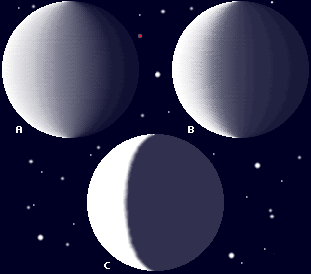
Shouldn't the moon crescent look something like A or at least B...? Nope - it's actually mostly like C...
The non-contoured moon
Q: When there is a half moon, you are seeing a circle cut in half. Shouldn't there be a smooth black to white (silver) gradient rather than this instant "white-one-half black-the-other" effect?
Answer 1: I think it works like shadows: it's almost a "binary type" transition, with a hardly visible transition contour, due to refraction effects. [V.E]
Answer 2: Is this perhaps because the surface of the moon is so rough and pitted - so light is reflected in a random direction? [A.R]
Answer 3: As a point of interest, if you look closely with binoculars you can see that it is not as sharp as it first appears. [M.E]
The Eclipse
Q: Why is an eclipse more harmful to look at than just the sun?
Answer 1: It is hard to look at the bright sun because your brain is wired to prevent you damaging yourself, but the eclipsed sun is not so bright and it is easier to defeat your internal programming. Unfortunately the bright bits are still producing plenty of strong ultraviolet light and will damage the retina just as effectively. Another added problem is that as the sun is not as bright, your pupils open up to let more light in. [M.E]
Answer 2: The sun is always harmful to look at, especially during the hottest hours of the day, with no clouds or other obstacles between it and your eyes. Even looking at the sun behind clouds is still harmful enough. The eclipse phenomenon DOES block some of the sun's radiation, but unless it's a full eclipse (which can occur only in a very limited region of the globe for a limited amount of time), the sun still has its full-bright appearance (and high radiation power and luminosity, even at an 95% eclipse level).
In other words, the (now crescent shaped) sun looks as bright as usual, and is as harmful as usual to the eyes.
Then why do we hear all those warnings about not looking at the sun without protection "during eclipses"? Plain simple, because we are more PRONE to look at the sun during an (expected) eclipse, in the hopes of actually seeing a portion of the sun "put out"! Whole minutes against split seconds, and you realize that eye damage probabilities increase a lot during these phenomena! [V.E]
Answer 3: As an added point of interest, I /did/ have a quick few 'glimpses' (without special glasses or filters) when the sun was about 98% blocked out during the 2001 eclipse. Much to my surprise (and in confirmation of answer 2), I could barely see any difference - and it looked as though the sun was fully there! After another momentary glimpse, I found that if I squinted a bit - then I could just make out that the sun was mostly hidden behind the moon's view. [editor]
Noise from the eye
You've probably seen this before whether you realise it or not. It's actually the strange geometric noise you see if you shut your eyes very tight for a minute.
Q: If you close your eyes, there is a very faint but noticeable flickering 'random light mess'. Is this simply 'damage' that has accumulated over the years, or is it some kind of brain activity? Can people who are blind also see this?
Answer 1: I think it's low-level 'noise' - much like the background hiss from tape-recorders, etc. [A.R]
Answer 2: (Daring an) Answer: Some of this "random light mess" is surely quasi-permanent damage to the eyes, due to high intensity light sources or other such causes. Another potential source is probably brain activity, more properly NOISE SIGNAL (yes, human neurons aren't immune to "noise", after all - they're based on electrical activity!). Normally, the S/N ratio of the "human CCD" is very high, but like real ones, this ratio drops significantly with low luminosity (in fact, solid-state CCDs are known for suffering from high noise at low luminosities). In fact it's easier to see this mess when closing your eyes or simply when it's too dark. [V.E]
Answer 3: I'm not entirely sure if people who are blind can see this, but I have heard that there are some blind people who don't see a thing - not even the colour 'black'... (kinda hard to imagine I know...) [editor]
Q: Also, if you keep your eyes shut very tightly for about a minute or so, various geometric patterns start appearing and 'evolving' (see picture). How does this happen?
Answer:
Unusual light filters
Q: Is there a kind of light filtering device which filters out the entire range of 'invisible' light (infra-red and ultraviolet) whilst retaining the full visible spectrum? Also, same question, but filtering out only the full visible light instead.
Answer:
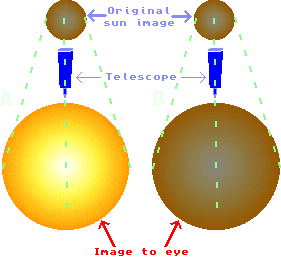
Would one see A or B ?
The Magnified Sun
Q: Why is looking through a telescope at the sun more harmful than usual? Isn't it just enlarging the size of the sun - not the brightness? See Diagram for clearer explanation of question.
Caution: Never ever look at the sun through binoculars or a telescope, as it can easily blind someone permanently for even an instant of viewing.
Answer:
Q: Is there a limit to how powerful a single telescope can get - given a certain size?
Is the size of telescope proportional to its zooming accuracy?
Answer:
Luminous Liquid Light
Q: There are certain types of liquids which produce their own light independently, or when mixed:
Can all the primary colors be obtained from these liquids or just white light?
Answer:
As far as I know - only a pale greenish blue light can be produced by these, but I could be wrong. [M.E]
Q B: If this liquid light was compressed, then would the light become stronger e.g. 5x compression = 5x light intensity.
Answer:
Unlike gasses, most liquids are almost completely incompressible. If you put the liquid under very high pressure, you might speed up the reaction, but you might stop the reaction altogether by changing the chemistry. The best way to find out is to do the experiment and see, but you would be unlikely to get much extra light from the liquid. [M.E]
QC: If the liquid was heated to become liquid-light vapour, would the air around become luminous?
Answer:
In this case the chemicals would almost certainly break down. If you wanted to get a luminous mist, your best bet would be to spray it as tiny droplets like an aerosol spray, but I don't think it would stay luminous for long that way... however, again the only way to find out would be to do the experiment and see. [M.E]
Q D: If the liquid was frozen, what effects would this have on the light?
Answer:
I would guess that it would stop because the chemical reaction wouldn't be able to proceed while the component parts are frozen in place instead of mixing freely... but again, the only way to know for sure would be to try it. [M.E]
Q E: What does the liquid taste like? Is it toxic?
Answer:
Q F: How long does the light last for?
Answer:
About an hour I think... [M.E]
Q G: How (if?) can you 'recharge' the light?
Answer:
Only by adding more of the two liquids to react together... unless you find some other material that acts differently. Lots of things produce light under various circumstances. Do you have any sugar cubes? Mint flavored Lifesavers will do. Go into a dark room and wait for your eyes to
dark-adapt. Get close to a mirror, pop a Lifesaver or sugar cube in your mouth and crunch down on it. It is called triboluminescence. Get a couple of quartz pebbles (ones smoothed by river erosion are best). In the dark as before, watch the stones carefully as you scratch one across the other's surface. Next time you are at a party where someone has an ultraviolet light, look at people's teeth, they will appear unnaturally white. That is fluorescence. Fluorescent tubes are called that because the mercury vapor inside them emits ultraviolet light. It radiates out and hits the powder coating the inside of the glass, which absorbs the ultraviolet and re-emits
lower energy light in the visible spectrum. (Incidentally if you ever get to see the powder on the inside of a broken tube, be careful - because I think it belongs to a class of very toxic compounds called PCBs that once absorbed, the body has great difficulty getting rid of. PCBs can cause terrible problems with your joints and make you very sick over a long time.) [M.E]
Answer 2 (to all liquid light questions)
"Chemical light" usually gives out greenish or bluish light, like most natural fluorescence phenomena... but I don't know how these substances' properties change with compression/expansion (liquids can't be compressed that easily, though (almost impossible)).
I think that there would be a maximum in the emission with a particular CONCENTRATION value of the reagents, and decreasing for non-optimum values. Other possible parameters would be external temperature and light: In fact phosphorescent substances are "suppressed" by strong external lighting, and "recharge", by absorbing radiation instead of emitting it, and vice-versa in the dark.
Temperature...hmm, depends on the substance. Most chemical reactions accelerate with higher temperatures, while there are some which may also take advantage of low external temperatures!
Also, these liquids are usually toxic - and last for approximately 6-8 hours. You may have seen these "emergency lights", which are a plastic/rubber bar of transparent material with a yellowish/greenish substance inside - and is somehow stiff. To "activate" it, you must bend the bar, making some internal diaphragm break, the substances reagents mix and they start glowing for about 8 hours. Can also be used underwater!
Unfortunately, the chemical reactions involved are usually irreversible, and thus you can't recharge them (much like a match that has burned all the way - unlike phosphorescent objects, which however last much less even if fully "charged" and glow much weaker). If the reagents are perfectly mixed, you can't even stop the reaction, once started.
Not only that, but the substances involved aren't eternal: in fact, those bars have an "expiration date" on them (usually 2-3 years). [V.E]
The Humble Light Bulb
Q: Light bulbs have not changed much since Edison first introduced them many years ago. They all still have one thing in common though - they run out sooner or later. If they exist, how much more expensive are the infinitely lasting light bulbs? If car lights and LEDs can last so long, then surely they can do the same for the household bulbs?
Answer 1:
You can now get light bulbs lasting up to 20 times longer than normal household bulbs. But I think they're duller than normal - and obviously more expensive. [editor]
Answer 2:
Car light bulbs: They are mostly incandescent/halogen, working at 12 V, but they are not eternal. They may be a little more "rugged" than household bulbs, but come think of it, you surely use them much less than a household bulb. It's just more difficult to see one of them burned (it's easier to see a broken one, by the way, or change the car before you even burn a single one) yet it does happen, sometimes. [V.E]
Q: The light coming from a coloured light bulb is (mostly) white and therefore requires a coloured glass bulb filter to show any colour. Can coloured light come from a transparent glass bulb? Also, what wavelengths of light do light bulbs emit? Is it 'coincidentally' just the RGB waves that are needed to make white light perhaps?
Answer:
I'm not sure about non-visible light, but I do know that most common household light bulbs emit intensities closer to the red end of the spectrum than the blue. This is confirmed with a simple experiment: compare the monitor's white to the reflected shade of a sheet of paper. Incredibly, it turns out that the average 100-watt bulb consists of about 49% red, 33% green and 18% blue - giving a very 'creamy' colour. [editor]
For a further breakdown of how poor light bulbs are, visit the Light and Colour Trivia page.
Q: Whilst we're on the subject of light bulbs, how many would it take to get the brightness that the sun gives out? 10,000 watt perhaps? Rooms would look great this bright :)
Answer:
Incredible - there is an answer to that :-)
On a winter day, the average illumination level for exteriors is 10,000 lux (1 lux = 1 lumen/m^2). So let's say you wanted to light a 5*5 metre room with 3 meter high walls, so that the total surface is 2*5*5 (ceiling, floor) + 4*5*3 (walls) = 50+60 = 110 m^2. You would need a 1,100,000 lumen light flux, which is definitively overkill! About 734 standard 100W light bulbs (at 1500 lumen each) would be required, with a 73,400 W total power consumption!
Too bad that more than 65,000 W would be pure radiation heat, so it would be pure suicide to sit in such a closed space with such a big heat source (imagine, a centralized heating for a house or even a small residential building is a mere 20 KW!).
With more efficient lamps, such as compact fluorescent, you would need about 917 21W lamps, with 1200 lumens each. The power consumption would lower to 'just' 19,250 Watt, and of those, just 9625 (50%) would become heat.
It's still far from ideal but a lot better already. When designing heating/cooling plants for interiors, the presence of numerous and powerful light sources is taken into account, as well as any kind of power-intensive machinery, and if possible incandescent light is replaced with fluorescent, especially with REALLY big places, such as auditoriums, university halls, warehouses etc.
But, attention, I mentioned a WINTER day, at 12:00 !
On a summer day, at 12:00, the illumination level is of 100,000 lux!
Tenfold the luminosity, tenfold the power and the heat!
Now, sure for a closed space you don't need an equally luminous ceiling and some walls will have windows which need no illumination etc. and so you can lower on those figures, but you understand that even the best household (and industrial use) illumination shrieks in front of
the power and efficiency of the sun, and you will always have to compromise.
Even if you take out the ceiling's and half the walls' surface in the previous example, it's still too unpractical, at least with the incandescent solution, while the fluorescent one seems feasible already, at least for an important application such as a nuclear lab or something, but not for a normal household.
In some applications it's possible to see daylight like illumination, for example sports fields - but it's an open air application, and you need to illuminate "just the pitch", not the crowd or the sky. Yet, we're talking about Megawatt-class halogen or arc projectors. [V.E]
Dazzling light and silhouettes
Q: When you are dazzled by a bright light source and what you see becomes a dark 'silhouette', is that what you are 'meant' to see - or is it some kind of fault with the eye or brain?
Answer:
It works like a digital camera with automatic gain control; the impulses from the camera are scaled so that the largest value represents white. When a very bright light is present, the impulses from objects with normal illumination are insignificant in comparison to the 'white-level' so appear to be silhouetted. [A.R]
This is what I suspected. Strictly speaking, the dark 'silhouette' is actually the same color - it's just an optical illusion with the eye that makes it look darker. [editor]
Can the blind see in dreams?
Q: Can people who are blind at birth see sights in their dreams?
Answer 1:
No, though they still hear in their dreams. They have no experience in what 'seeing something' would feel like, so they have nothing to relate to when dreaming either.
If someone goes blind after the age of 6 though, then they're still able to see in their dreams for many years afterwards.
There is a twist to this story though. Around 75-80% of people who are blind from birth have been able to see during a 'Near Death Experience'. It's truly the only time they've been able to 'see' something, so there could even be a paranormal connection. See here for more information regarding the NDE phenomenon. [editor]
The Perfect Microscope
Q: How close is technology to this kind of microscope:
First stage: Monitor display. Real-time zoom in or out operation with 4-way real-time scrolling. The speed of scroll would be proportional to zoom level.
Second stage: Same as above but with picture displayed in 3 dimensions with auto-focus and near to infinite zoom potential. On top of ordinary zooming, there would also be an option to /enlarge/ the screen's picture. Other options such as moving and rotating the object and/or lens could be added. Perhaps a variable focus setting enabling everything or a defined distance (or anything in between) to be displayed.
Answer:
Effects of Speed of light at 1 MPS
Q: What would everything look like if the speed of light was slowed down to - ooooh... right down to 1 metre per second ?
Q: Apparently, a microscope can only zoom in so far before visible wavelengths of light become inadequate to reflect the object. Is this a fault ('fault'?) with the microscope or is it the very nature of light? If it's the second explanation that stops us from seeing closer, then isn't it possible to shine higher frequencies of light on the subject and then cycle (transpose) down the colors to what they should be?
Answer:
Yes, light wavelengths become inadequate for very small details. That's why the electronic microscopes are used for making all those microbes etc. photos: they really use ELECTRON BEAMS in quasi-vacuum, and can "see" details at electron-scale, which is below 1.0 E-17 meters, much smaller than the smallest visible wavelength, at 400 nm (400 E-9 meters). But then, you can't see any real colors! That's why those electronic-scan photos are almost always coloured in "pseudo-colors", fake colors attributed by a computer according to various criteria, like electron beam "thickness", polarization, absorption, etc. [V.E]
Advances have been made in seeing ever smaller details with light alone. Visit here for one such technique.
Multiple Focus Lens
Q: Is there a lens which shows all parts in focus simultaneously?
Answer There are some "progressive" or "multi-progressive" lens which have a special profile, which enables to use the same lens to read a newspaper and to look at the horizon...with no adjustment! The trick is that different zones of the lens have different focus point, and the transition from minimum to maximum is, as the name says, progressive. The closest focus point is usually on the lower part of the lens, and the farthest right in the center.
But a lens showing any given arrangement of objects at any given distances from the observer and all perfectly focused...well, that would require an "ad-hoc" lens for that particular scene, with a particular focus geometry. Maybe they could make special lens for particular cases, e.g.
lens for computer workers, with a central focus point of about 50cm (for looking at the monitor), about 35-40 cm for focusing the keyboard by just lowering the eyesight, and the peripheral zones of the lens focused at, say 2 meters up to the infinite for the rest of the work area and talking to colleagues.
Otherwise, to fit PERFECTLY any particular need, you would need a "T-1000" liquid glass auto-morphing lens :-) Or just a clever balancing and choice of central focus point, like professional photographers do. [V.E]
Street Lamps, Sky and Auras
Q: At night when you look out, the sky is a sort of dull dark brown. If all street lights and lamps were switched off, would the sky instantly turn pitch black?
Answer 1:No, (cloud permitting) you'd be able to see the moon and stars! Seriously, though, the brown would dissipate quickly enough for humans to perceive it as instant. [A.R]
Answer 2: On a clear, starry night without clouds or smog of any kind, yes.
That's why, for example, they build astronomical observatories far away from big cities or even the smallest urban center: in fact, urban centers concentrate a lot of clouds and smog for many causes linked to heating, pollution, etc. and the lights cause a lot of reflections and make the clouds glow with a blurry orangey light, which is absolutely devastating for astronomical observations, as the light reverb "blinds" telescopes.
On a cloudy night but without excessive artificial light, then usually you can see the moon colouring the clouds with a greyish-bluish color. [V.E]
Q: A street lamp at night has an aura of light around it. Is this a fault of the eye or is it just the surrounding air and dust particles reflecting light (just like fog and mist)? Or is it both maybe?
Answer 1:
Some of both, but mainly it's the dust and particles which cause light diffusion, which is easier to observe in a dark street with few isolated light sources. [V.E]
Obviously in this case, there's also the brightness of the sky to take into consideration, but just pretend this was on the moon or something :)
Soft Shadows and Light Sources
Q: If you study the shadow of a particular object, you may find that its edges aren't sharp. This is generally referred to as a "soft shadow". Is it true that if all the light were concentrated into one point, the shadow would become 'sharp'?
Answer:
Yes, if all light were emanating from a single point, and no secondary light reflecting of surfaces came into play. [V.E]
Answer 2:
There is another factor to consider in determining if a shadow is sharp or not. Light, when passing near objects, actually bends (we're talking on a very small scale). This would be responsible for you never being able to get a truly sharp shadow of an object if you look closely enough - even if light were concentrated into one point and the diffusing effects of the atmosphere were taken into account. [Thanks: Kelly Mauthe]
Colorless Gases and Liquids
Q: Is pure air absolutely transparent (colorless) so that if you were to look off into the distance miles away, the horizon would be just as clear as the foreground?
Same question with oxygen, nitrogen, helium and water.
Answer: On a day without clouds, low humidity, no pollution, etc. you can spot an island or a distant mountain chain from, say, 50 km or even 100 km in some cases, and you surely see objects clear enough even from several kilometers, but after a certain point, the refraction index of pure air (which is not 1, although very close) will cause blurring anyway, and you'll just see a shape, maybe a contour (seen this myself). The limit for the horizon, in normal circumstances is around 20 km by the way. [V.E]
Communication and Monitor Display Technology
Q: How close are we to the kind of technology which allows sound and visual connection between two people miles apart via a 50 Hz screen refresh not
more than a centimetre thick?
Answer
We're almost there: Think about GPRS/UMTS mobile technology, and third generation mobile telephony in general. The maximum bandwidth available per user (up to 2 megabits/sec) and accessories such as digital cameras which are already available for some mobile phones (even though they're just for still pics or short films, at best) make this possible. In fact, TV-on-demand and video-calls will be some of the most advanced services offered by this technology, but at least initially, high connection and hardware costs may discourage people from using it. Initially in fact, many GPRS/UMTS phones will just be extensions of their GSM counterparts, and surely not all will have the hardware (CPU's, color screen, built in camera and software etc.) needed for video services. Many service providers may not even bother to offer them except for the most expensive, top-of-the-line "terminals" (that will be the term referring to the new "cell phones", in fact, as they will be very similar to today's palmtop computers) and for the most demanding users. Most others will be OK with standard voice telephony via UMTS/GPRS, higher audio quality, and maybe a better mobile internet access (not that WAP crap), downloadable games, real-time news, m-shopping, etc.
Interesting side effect: The effective "action range" of these "terminals" will be reduced, compared to standard GSM or DECT m-telephony, which was also reduced compared to analogue mobile telephony such as TACS etc.
In fact, the operating frequencies will be in the range of 2 GHz, and much more antenna bases (5 times as much as for GSM) will be needed to assure a comparable territorial service. These frequencies also have a worse penetration inside construction materials concrete, bricks, etc.) and very probably special "antenna bricks" and interior antennas will be used for re-transmitting the signal inside and through houses and building. [V.E]
Q: The perfect screen display: How far off into the future is all this?
Completely flat, air-light monitor with adjustable size (naturally). Definable resolution and perfect screen update with all the other usual brightness and contrast controls would make a superb monitor. A 3 dimensional display could be an option too with adjustable "Z axis" stretch and start/stop point. Distance of picture and horizon could be changed in any way possible.
Maybe some kind of holographic image technology could be used here?
Answer:
Holographic displays are good many years into the future, due to the incredible amount of processing power required. There is apparently already a holographic display which allows parallax horizontally, but not vertically. It can only do a few frames per second though.
Software exists for calculating full 3d holograms, but currently takes a few hundred thousand years to calculate a frame! A job for Distributed.net methinks... [A.R]
Q: Do any of the new thin TVs have a no-flicker display (i.e. no bar rapidly moving down the screen) ?
Answer:
Blue and Yellow really green??
Q: Why is 'everyone' taught that blue and yellow make green? Simple
knowledge on the basics of colour should show that the actual colour (for additive AND subtractive mixing) is black/grey/white. (In the same way, red+cyan and green+magenta also equals black/white...)
Q: Where is magenta 'meant' to be in the color spectrum - after blue or before red? The 'blue' (shorter wavelength) end of the visible color spectrum contains magenta/purple/violet/indigo (red/blue mixes). It seems that red also exists after blue!
Effectively, this implies that there are 1½ reds in the color spectrum (!)
So what's going on? Did it get second helpings?
Answer: In a very real sense, red is getting second helpings. Due to a small idiosyncrasy with the design of the eye, blue wavelengths activate the blue cone, but surprisingly also activate the red cone. The reverse doesn't happen however - red wavelengths don't stimulate the blue cone. To answer the first question, magenta itself doesn't appear in the visible spectrum. You need to mix blue and red wavelengths 'artificially' to achieve magenta. [editor]
Visit the Light and Colour Trivia page for more information about this.
Reverse Colour and the After image
Q: If you look through a yellow filter for a few minutes, everything afterwards appears blue and vice versa. Is this a 'fault' with the eye or mind? Or is it
because the sudden switch confuses the mind? Basically, are we really seeing what we should be seeing?
Answer 1:
Color complementation. The yellow filter (red+green=yellow) creates a blue "scompendium" in vision, and vice versa, which the brain tries to compensate by changing the blue balance (or yellow, vice versa). When removing the scompendium cause, what you see is the "extra" balancing layer. Identically, staring at a green filter should cause a purple/magenta "scompendium" in vision. The last question is too philosophic for me... watch the film "Waking Life" or read the book by Michael Ende "Der Spiegel im Spiegel" (the mirror inside the mirror) for a possible answer... [V.E]
Answer 2:
The human vision system attempts to compensate for the filter. This adjustment takes a few minutes! As for whether we're really seeing what we should be seeing, there's no fundamental law of how colours should be perceived, it's basically just a quirk of how our vision system has evolved. Other creatures have markedly different vision systems, and seem to get along just fine! [A.R]
The Mirror Timebomb
Q: What kind of effect would you see if an object (with a light source) was surrounded by a mirrored sphere?
Also, if a pulse of light was released (this time with no object) inside a closed mirrored sphere - and no energy was lost through heat, would the light remain indefinitely - evenly spread throughout the sphere ?
(If so, then this effectively means that if the light were to stay constantly on, the brightness inside the enclosed mirrored sphere would increase infinitely!!).
Answer 1:
If the mirroring was perfect, such that the light beam wasn't split during the reflection process, then the result would be a pulse of light bouncing around inside the sphere indefinitely.
If the mirroring was imperfect, such that the light beam was divided by each reflection, then the pulse would be rapidly split into more and more pulses, with each generation being dimmer than the last. Eventually an observer would perceive the sphere to be filled with very dim light, evenly spread throughout the sphere. (Of course, if an observer is able to see the light, some of it is escaping ;^)
If the light were to remain on, then yes, the brightness would indefinitely increase. So it's just as well this question is hypothetical. [A.R]
Answer 2:
Very interesting question. Yes, as with any energy form trapped in a closed non-dissipative space - the light would theoretically increase indefinitely. At some point, however, the spatial energy density would cause other interesting side effects, such as extreme heating and destruction of either the lamp or mirror surfaces (we can exclude this however, if the mirror surfaces are 100% reflecting and the light source is transparent). Other possible effects could be a partial conversion of energy into mass (for extreme energy densities), and maybe even nuclear reactions of that mass, exposed to extreme heat and radiation pressure.
Assuming that the sphere is "full" of perfect vacuum, nothing is sure, though.
The most minimal quantity of matter, even one molecule of gas or air, however, could be seriously affected by this spatial energy density (which could be as high as the whole energy of the universe, for what we know).
Uhmmm...maybe we found the key to the big bang and we don't know it yet :-)
As for what you'd see - much would depend from the wave length of the light used, and its position. When two wave fronts (all waves belonging to the same wave front are considered
coherent in 'our' example) having opposite phases (which are considered random, generated by the light source, but equal all over a spherical wave front, hence, 'coherent') meet, they cancel each other out, and if their phase is equal, they add up, allowing for intermediate situations too. The result is that spherical shells, some dark, some brighter, will appear now and then inside the lighted sphere. With a source having a definite function of POLARIZATION, though, it's easier to create stationary interference phenomena, like STATIC dark-bright alternance of spherical shells, or moving at various speeds. In that case, it's the polarization state which
can create an extrinsec phase difference between the wave fronts.
After being reflected from the interior walls of the sphere, which we assume completely reflective, non-dissipative and without superficial imperfections, the rebounded wave front would return (contracting) to the center of the sphere and then, after "reversing its inside's out" by passing from the center again (we assume than it can cross it without any phenomena of any kind) it would expand and bounce again from the wall, and so on ad infinitum.
If the wavelength is chosen wisely (comparable to the sphere's radius for the example), then interference effects would build up. You could see dark and light concentric spheric shells either standing still, or moving from or to the center of the sphere, at random positions, slowly or stunningly fast, depending on the sphere's radius. A kind of visual resonance effect. [V.E]
Warning: What I described is an idealized (and extremized!) physical situation, which has too many limitations and problems to be put into practice, the least of which is that it would be difficult to observe the inside of the sphere without disturbing it, and that no know light source is omni-directional, punctiform, transparent to radiation, and single-wavelengthed. LEDs are surely small and powerful and wavelength-precise but are far from omnidirectional and punctiform, not to mention transparent...Not only that, but to cause such an accentuated interference effect, either the wavelength would have to be metric or centimetric in measure (which means FM Radio waves or Microwaves at most (not even Infrared), and thus invisible to the eye) or the sphere itself would have to be really tiny (just micrometers in radius).
What you would see in reality, if you could become invisible and transparent, would be just a hashy, lighted-up space, with many distorted reflections of the light source (say, a candle or lamp) appearing at various distances, up to the infinite in many overlaying layers each one appearing less bright and more distant than the previous one, lamp shape), many ghost images, many interference areas and serious size/form/color distortions, and (maybe), in certain interesting situations, if you come up with the correct wave length, even a flickering/movement effect. Not only, but the image coming to the observer would change very rapidly for even the slightest movement! [V.E]
For a cool demonstration of this phenomena and its effects, visit the Light and Colour Trivia page.
Tasting the Impossible
Q: Colour and sound have easily been quantified. Visible light is split into red, green and blue.... and music is made up of countless waves of air pressure (which can be represented mathematically).
However, are there fundamental attributes to the sense of taste? (and I'm not just talking about the senses of the tongue here, but the sense of smell.)
Answer:
Q: Is it possible to change the colour of water to pitch black - without affecting the taste or texture?
Answer:
Yes (miracles of chemistry!). There are so many colorants used by the food industry, that all soft drinks are basically just coloured water with the addition of artificial aromas and some sugar and CO2. Most of these colorants are completely tasteless and texture-less and some come in even in fluorescent colours! [V.E]
Q: How about water with the opaqueness of say... oil. Are fully opaque (non-translucent) tasteless colorants possible?
Answer:
Q: What would water 'taste' like if it had the texture of something like
plasticine or Ice-cream?!
Answer:
There are some watery gels around...anyone like a taste ? :-)
Unluckily, tasting them would not help a lot (assuming they aren't harmful, which may not be true) as the taste would be affected by the other addensing chemicals present in the mixture.
Maybe tasting ice would help understand...pure water ice which has absorbed no odours (which is harder to obtain than one may think) has pure water taste - why not gel then? [V.E]
Extreme Wavelengths of Light
Q: What's at the far ends of the electromagnetic spectrum? Any chance of these extreme wavelengths producing unusual and unforeseen effects?
Answer:
There are the ELF (Extremely Low Frequency) waves, below 50 HZ, used for submarine communications, and the highest gamma radiation naturally emitted by some atomic nuclei is at about 2E26 Hz. No electronic oscillator can go beyond some GHz's, and visible light, IR and UV and even X-Rays are produced by difficultly-controlled physical phenomena, such as heating, brehmstrahlung, filtering etc. Only nature can go beyond (or below that!). There's a lower limit too, as creating an ultra-slow oscillator by electronic means would require extra-large capacitor and super-inductors, that a mechanical mean would work better in this case, or maybe natural phenomena such as earth magnetism. [V.E]
Q:
Is it true that the shorter the wavelength of light is, the more chance the ray has of going through a solid object? And is it exactly proportional i.e. half wavelength means exactly double penetration?
Answer:
Higher wavelengths have greater penetration (don't know if it's linear, however), but there are exceptions. For example, the selective absorption of ultra violet radiation by the ozone layer (due to particular molecule-physics of the ozone), or the almost complete reflection of AM/MW
waves by the ionosphere. X-rays are surely the most harmful in the short term. I'd prefer 5 minutes of infrared to 5 Minutes of X-rays or intense UV. The worst Infra-red can do to you, as far as I know, is to...warm you up. [V.E]
Deadly Rays, Microwaves and Lasers
Q:
At the same amplitude, what exact frequency of light is least and most harmful to expose oneself to? Ultra violet or Infra red? Radio waves or X-rays?... Same question, except this time which is most damaging to the eyes?...
Answer:
Q: I've heard that if you take the lid off a CD drive while it's on, the laser can blind you. How true is this? Is it permanent blindness? (warning - don't try it)
Answer:
You can't see the laser, yet it exists! In some CD drives you can get a small skin burn if you leave, say, your finger for too long over the lens. Damage to the eye should be of a degenerative kind: e.g. you don't sense it immediately, but you start seeing worse day by day, in an irreversible manner. [V.E]
Q: Exactly how dangerous is it to remove the microwave generator from a microwave - would you notice it just heat you up, or would there would be invisible danger which isn't immediately apparent? (warning - don't try it).
Answer:
Light Waves and Heat
Q: Which frequency of light from the sun produces the least heat? What frequency produces the most heat?
Answer:
Most of the energy from the sun falls from far Infrared to far Ultra violet, and the "most heating" frequencies are the IR ones, which are emitted by all heated bodies (any body above 0 K). That's the reason for making IR heaters. IR radiation is well absorbed by most physical bodies. [V.E]
Do certain materials prefer one frequency (say, X-rays) while another material might cook better under infra-red rays?
Answer:
Yes, there are some "preferences". For example, the Ozone gas strongly absorbs UV rays, while watery molecules (but also fat and carbohydrates) have resonation frequencies close to 2.5 GHz, which is the microwave zone. [V.E]
Tons of light and no heat?? Tons of heat and no light??
Q: Could something be very hot (say... 1,000,000°) and still have no light being emitted?
Answer:
All objects at a temperature above absolute zero emit some kind of radiation, with an almost continuous spectrum. [V.E]
Hmm.... 2 further questions:
Could something be 1,000,000° and have no visible light being emitted?
Also, if you ignore the heat that the resulting rays produce - could it be possible to have something at that extreme temperature and have no heat generated from the source?
Answer:
Q: Reverse of above question: Could something be very bright and still have no heat being generated?
Answer:
Light generation would still require a power source, and no 100% efficient method for converting energy into light is known, yet I don't think it's prohibited by thermodynamic laws.
Nevertheless, this luminous radiation would at some point be converted back to heat (that's for sure) but not necessarily at the source.
For example, a "cold" lamp of that kind would remain at room temperature, and the only heat generated would be the one from radiation transmission (which would be equal to that generated by an equally powered "hot" lamp, by the way. Energy can't be created nor destroyed.)
Actually, this problem falls into the more generic problem of converting any kind energy into EM field energy. [V.E]
How many unique pictures could you ever see?
One of the pictures in the 900,000,000 digit number - and not at all a blatant excuse to display one of my Gallery pictures... ;-)
Q: How many uniquely different pictures could you ever, ever see?
Answer:
The amount of digits that the number of possible pictures contains is approximately 900,000,000 !
This covers every single picture you could ever possibly see. From a picture of you - to a picture of your own house, to a picture of the ocean or sky - every possible sight is contained within this number... [editor]
For a further breakdown of how I reached this number, visit the Light and Colour Trivia page.
The poor green light on monitors
Q: Why is the green light on my monitor so pale? Are all monitors this bad?
Answer:
Mostly - yes. For some curious reason, Cathode ray tubes have trouble displaying a rich true green. Even worse though is the cyan color which is very insipid. Try this optical illusion below to see how much stronger Cyan can get. [editor]
The Eclipse of Mars - See a new colour you've never seen before!!
...Well... at least never before on your monitor.
The colour you are about to witness is actually true Cyan ... a colour that is heavily diluted on the vast
majority of monitors (thanks to colour pollution). It's a pity one needs an optical illusion to demonstrate this, but at least you can see what you've been missing ;-) Anyway on with the illusion....
Stare at the white dot in the centre of the red circle. The longer - the better (two minutes and you'll get a much stronger effect). Always try to keep focused on the white dot. It'll be worth it.
Soon after staring, you'll start to see a thin rim of light around the edge. Don't stop staring though yet! Wait another minute - keeping your head perfectly still.
Once you've done this, slowly - move your head backwards - making sure to keep your eyes focused on the dot at all times. The circle's rim will glow brilliantly with true Cyan! Keep on moving your head slowly backwards, and it'll glow very hot!...
The blue/cyan colour chart to the right isn't part of the illusion, but there to demonstrate that the ultra cyan you have just seen is not in the monitor's color palette! It should be, but isn't.
It's an amazing effect and I'm happy to say I 'discovered' it =D These 2 colours (red and this exact shade of cyan) work better than any other colour combination for many reasons, but click here for the ultra-brilliant green version.
Also visit the Optical Illusions page for some unique never-seen-before Optical Illusions.
Message your comments and possible answers to the Skytopia Forum
 This symbol means that the question is difficult to find out in practise. However, through lateral thinking and common sense, an answer is possible.
 This symbol means that the question is nigh-on impossible to verify by experiment alone. However, through lateral thinking and common sense, an answer is possible.
 This symbol means that the question is delving into the theoretical realm and is once again difficult to test. The answer/s are possibly right - but not guaranteed!
 The ultimate! Questions with this symbol push the boundaries of theoretical knowledge - and are nigh on impossible to verify by experiment. Any answers are based on our current understanding of the universe - and thus are subject to error.




 Q: There are certain types of liquids which produce their own light independently, or when mixed:
 Q G: How (if?) can you 'recharge' the light?
 Answer 2 (to all liquid light questions)
 Q: At night when you look out, the sky is a sort of dull dark brown. If all street lights and lamps were switched off, would the sky instantly turn pitch black?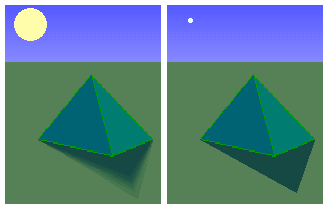
 Q: Why is 'everyone' taught that blue and yellow make green? Simple
knowledge on the basics of colour should show that the actual colour (for additive AND subtractive mixing) is black/grey/white. (In the same way, red+cyan and green+magenta also equals black/white...)
Q: Why is 'everyone' taught that blue and yellow make green? Simple
knowledge on the basics of colour should show that the actual colour (for additive AND subtractive mixing) is black/grey/white. (In the same way, red+cyan and green+magenta also equals black/white...)
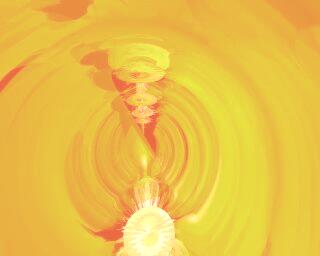 Q: What kind of effect would you see if an object (with a light source) was surrounded by a mirrored sphere?
 majority of monitors (thanks to colour pollution). It's a pity one needs an optical illusion to demonstrate this, but at least you can see what you've been missing ;-) Anyway on with the illusion....

 Mirrors inside mirrors
 The non-contoured moon
 Noise from the eye
 The Mirror Timebomb