The World's most unanswered science questions: Physics
Everything to do with Physics - movement and matter is covered on this page. Before diving straight into the questions, here's a quick table showing the special symbols and what they mean.
This symbol means that the question is difficult to find out in practise. However, through lateral thinking and common sense, an answer is possible.
This symbol means that the question is nigh-on impossible to verify by experiment alone. However, through lateral thinking and common sense, an answer is possible.
This symbol means that the question is delving into the theoretical realm and is once again difficult to test. The answer/s are possibly right - but not guaranteed!
The ultimate! Questions with this symbol push the boundaries of theoretical knowledge - and are nigh on impossible to verify by experiment. Any answers are based on our current understanding of the universe - and thus are subject to error.
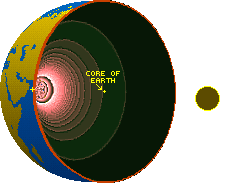
To understand how the moon has seemingly more gravity than it should, take a look at this diagram of Earth. The brighter shades indicate a stronger downward pull of gravity. Incredibly, over half the 'gravity power' is coming from your immediate vicinity - beneath where you're standing. (see diagram:- area 'inside' bright white arc)
Gravity of moon 'wrong'?
Q:
If the mass of the moon is low - about eighty times less than the earth, why is the gravity so high (about one sixth that of Earth's)?
Answer:
The reason it's more intense than (1/80)g* even if the mass is 1/80 of that of the earth, is because the 'pulling power' from the other side of Earth is relatively very small (see the darker green areas in the diagram).
Moon gravity force measured at a height from the center of the Moon equal to the earth radius, would naturally give a much smaller value, and precisely (1/80)g, if we assume Moon/Earth mass ratio =1/80. Gravitational force is proportional to the inverse of the distance's square (1/r^2). [V.E]
*where g= gravitational force of the earth, about 9.8 newtons per Kg)
Diamond's melting point. Is Liquid Diamond possible?
Wow. Here you can see diamond melting on a surface at 5,000 degrees - and turning into something not entirely dissimilar to liquid mercury!
Q:
(If possible) what temperature does diamond itself melt at? and...
What temperature does the surrounding air have to reach to melt the surface
of diamond?
Does it crack or burn first before it melts?
Answer:
Diamond DOES HAVE a liquid state, only it's hard to obtain - even with sufficient heat.
At normal pressures and in the presence of air, a mere 400 degrees Celsius will make it catch fire, and turn it into CO2*. Below that, it "skips" the liquid state and sublimates.
Liquid state for diamond is reached at 3500 degrees Celsius, but it needs a low oxygen presence and great external pressure to keep it from sublimating or burning [V.E]
* Even CO2 has a liquid state, but only at a high pressure: at it's triple point, where liquid/gas/solid coexist (5.4 atm pressure).
Also see this off-site page at nature.com for more information on the melting point of Diamond.
Liquid Gold
Q:
Same 3 questions with gold instead of diamond?
Answer:
Gold on the other hand is much more predictable: melts at 900 degrees Celsius, and does so gradually, much like the solder paste on an iron solder's tip. It may emit some vapour, though (gold vapour, wow!) [V.E]
Carrots, Karats and Carats
Q:
What is meant by 16 or 24 carat gold? Isn't it simply equivalent to the weight or density of the gold:- Does carat=weight/density?
Answer:
The carat was, originally, a weight measurement unit for precious stones, gems, etc., and is worth 1/5 of a gramme (200 mg).
The "karat" (note the "k" instead of "c") intended for gold, on the other hand, is a dimensional purity coefficient: 24 karat gold is pure gold, while 18 karat gold means that the "gold" you are dealing with is in reality a mixture of gold and some other metal, usually silver, copper, platinum, iridium, palladium, nickel or ever quicksilver.
18 karat gold means that there are 18 gold parts out of 24 in that particular alloy, and the rest can be anything from the above, pure or a combination of them. [V.E]
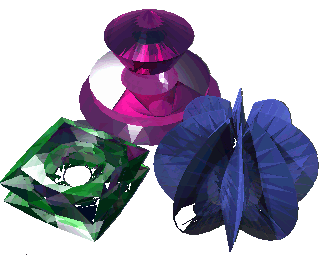
Here are some shapes you /won't/ tend to find diamond in, as they are can only be cut at certain angles (the direction of the diamond lattice).
Moulding diamond
Q:
Can diamond be moulded into any shape?
How thick would a diamond sheet have to be to survive the force just
about required to break a glass window?
Answer:
Diamonds and speeding bullets
Q:
How thick would a diamond sheet have to be to stop a 'typical' speeding bullet passing through? Give comparisons with glass, wood and other common materials if possible.
Is the so-called 'hardness' property of a material proportional to the amount of that material that's needed to stop a bullet? Or do other factors such as 'tensile strength' and 'elasticity' come into play?
Answer:
Floating hollowed-out diamond-shelled spheres full of helium
Q:
Is it possible to make an ultra-lightweight but ultra-strong object such as a diamond surface sphere? If the inside was even filled with air, the sphere would float in air and drift down slowly - very "unnatural" for such a hard object, eh?
However, if the inside were filled with helium, the object would most definitely stay afloat or even rise. Of course, the surface would have to very thin - that's why diamond would be so ideal. I wouldn't mind a floating crystallised sphere or similar in the living room as an ornament. Or a few thousand mini floating spheres could be fun!
Answer:
Spherical repelling magnets
Q:
Can certain types of magnets in the shape of a sphere attract or repel all around the sphere equally? Is there theoretically any possibility of this with nanotechnology?
Answer:
The magnetic lines configuration will tend to assume a "non-offending" configuration, such as all-North or all-South lines. Such configurations are impossible in nature, as no magnetic body can be a magnetic monopole, and all magnets have to have a "North" and a "South", unlike, say, electric charges or gravity masses. Not only that, but the magnetic lines have to be "closed", they can't just spawn out of nowhere and head to nowhere - or spawn from somewhere but end nowhere.
That means that the sphere will configure itself in a way that the magnetic lines exiting from it (North) will be equal in number to the ones entering it (South) and all lines will be closed lines, eventually at infinite. One way is a single North/South pole configuration, or even a
Multiple-pole configuration (they are possible, for particular geometries). [V.E]
Magnets in space
Q:
Do magnets work in space? And if you were to tie a magnet parallel to a piece of metal, would there be constant force between the two which would make them start to move even from a still position and accelerate forever?
Answer:
Magnetic fields work in space, surely.
The forever accelerating metal-magnet configuration won't work, because the metal, once pulled by the magnet, will pull the magnet itself until they collide and bye-bye acceleration. If they can't move one in relation to the other, then there will be no movement at all, even if there /is/ a constant force (it's an internal force to the metal-magnet-bond system (action-reaction principle) ). Much like trying to blow wind on a windsurf's sail with a fan that is planted ON THE WINDSURF itself: There will be a windstream, yes, but the fan will be pushed back by it, pulling the boat back, while the windstream tries to push it forward. This could work only with an EXTERNAL ventilator (not ON the boat). [V.E]
Q:
Does a magnet's 'pulling' strength last indefinitely, or does it fade over time?
Answer:
This depends on various factors such as if the magnet was man-made or not, and whether external power sources are nearby. Under best conditions though, even the most resilient magnets will fade gradually over thousands of years. Also, in some cases, it's even possible to 're-energise' a magnet that has lost its power. [editor]
For further information, visit this interesting page - Magnet FAQ
Natural repelling/attraction of ANY substance
Q:
A magnet will attract certain kinds of metals, but is there some material which can naturally attract absolutely anything, without having to resort to gravity?
Is there any theoretical chance of this (perhaps with nanotechnology)?
Like-wise, is there some natural 'repelling' material? After all, atoms are doing this sort of thing all the time on a much smaller scale.
Answer:
'Cold' metal and heat conductivity
Q:
Why do metal objects feel colder to touch than other objects? Is the amount of heat it conducts equal to the amount it gives out?
Answer:
Metals don't have a "naturally low" temperature or "natural coldness" (or, on the opposite, a "natural extra hotness" when heated) as many people think (or are induced to think by experience).
What's proper to say, is that practically all metals have quite a high heat conductivity (above 400 W/(m°C)), and conduct heat very efficiently and rapidly. When touching bare metal (say... say 20°C - room temperature), heat from your finger transfers so quickly to the metal that you intensely feel high temperature gradient, and so your body is fooled into thinking "cold"! [V.E]
The "W/(m°C)" diciture means that 1 Watt of thermal power is transferred for every Celsius degree of temperature difference and per meter of thickness.
But if you touched a piece of Polystyrene or wood at the same temperature (both these materials being thermal isolants), the sensation would not be that intense, if any. That's why many people prefer parquet floorings instead of marble or ceramic tiles, which are both mediocre heat conductors, not as good as metals but nevertheless much more conductive than wood.
Conductivity values for stone are around 1-10 W/(m°C), while for wood and watery substances in general under 1 W/(m°C), while for most gases, including air and water vapour, below 0.1 W/(m°C). Diamond is an excellent heat conductor, almost 1000 W/(m°C) !
The "cold" illusion works vice versa too: A chicken or even better, a CAKE cooking in a gas or electric oven inside a metallic dish: The temperature inside the oven is, say, 250°C - more than enough to burn! Say you wanna check the cooking point of the chicken/cake: Try touching the oven's glass: Hot, huh? Now try touching any metal part close to the glass: OUCH! Much hotter than the glass! Are you sure? Go on, open the oven. The hot air (at 250°C) invests you...yet you get no skin burns! You touch the cake/chicken barehanded: It's hot, but bearable for some seconds, especially the cake.
Now try touching the metal dish: OUCH! Unbearable for even 1 second! Now what has happened? Wasn't all the stuff at 250°C ? So why the air was "colder" than the food being cooked and the dish was even hotter ???
Again, thermal conductivity is the key: High for the metal and relatively high for the glass, too, lower for the chicken (which contains a lot of water) and even lower for a cake or loaf, which are almost dry and non-metallic, and even lower for air.
Due to different grades of insulation/conductivity, these objects/materials produce VERY different feelings to the touch...even if they are at the same temperature. That's the trick behind, say, those "coal walkers", people who walk (barefooted!) over hot coal. Coal may also be at 400°C, but conduces heat poorly, so it takes a long time to completely cool down and a reasonable amount of time before causing burns to bare skin (which is thicker on the feet, BTW) and pain, without anaesthesia or mystical rituals. Almost everybody can do it...yet try and ask these people to walk over a metal plate at half the temperature, or even just 100°C: 2nd or 3rd grade skin burns, that's for sure, and immediate pain with just the first step! [V.E]
The taste of liquid nitrogen, oxygen, hydrogen and mercury
Q:
What's the difference between the taste of water and the theoretical taste of liquid nitrogen? How safe is it to touch or even drink?
Answer:
A: Bleah...liquid nitrogen? You would have to drink it at -100°C, just for keeping it at liquid state (it's a cryogenic liquid). The gas however has no odour, and is toxic if inhaled in large quantities. At liquid state, even touching it would cause immediate freezing and loss of a member... (fingers, hand, etc.), if kept for too long. Kinda like T-1000 submerged by liquid nitrogen in "Terminator 2 - Judgment day". By the way, the Latin name for Nitrogen is "Azotus" which in turn comes from Greek "A-Zwto", meaning "without life", "unfit for life". [V.E]
Q:
Same questions with oxygen and hydrogen.
What on earth does the poisonous liquid mercury taste like? Any volunteers?
What also on earth would liquid diamond or gold taste like if it was cool enough to drink?
Answer:
(!): I may have just tasted mercury when I was little (I surely didn't swallow it, but when my parents found me, 3 years old, near a broken thermometer - they got pretty scared of course and took me straight to hospital)... Anyway, I recall a metallic, slightly play-doh like taste however, when I think of it...hmmm :-)
However I don't remember the episode very well, I may as well have not tasted it at all. I've heard however by a friend of mine, that he once dipped his finger into a mercury basin, and it didn't "moist" his finger, not even any tiny "mercury drops"!
For gold and diamond...the best thing would be to give it a bite.
Liquid gold is too hot...as is liquid diamond.
Gold however REALLY can be tasted, if laminated in thin sheets. I'm not kidding - I've seen "edible pure gold sheets" being sold on a Xmas catalogue as a garniture for sweets and drinks, after finely trimming them in tiny gold-flakes, of course. The company selling it claimed that gold is a benefic oligo-element (such as iron or calcium) and that once it was a privilege of kings and nobles, thought as a healthkeeper, anti-ageing, etc. even an aphrodisiac!
Not only that, but (surprise-surprise!) I once tasted an Italian sweet grape (a strong alcoholic drink, at 40°) which had tiny gold flakes in suspension! The grape tasted OK, although a bit too sweet. I drank it with the gold of course, but I don't remember any particular flavour...nor was it easy to "chew" on a gold flake. Well, if that wasn't a "royal" treatment... :-) I don't remember the brand, unluckily. [V.E]
Deadly cold
Q:
If one were (unwisely I might add) to dip their hand into liquid oxygen for a split second, would it eventually recover and in the short term, what would be the best course of action: To immediately soak the hand in cold or warm water perhaps?
Same questions but with liquid helium, liquid nitrogen and liquid hydrogen.
Answer:
If living tissue is immersed in liquid oxygen, or any other extremely cold liquid, as the water content in the liquid freezes, the resulting ice crystals would cause irreversible damage to the tissue (Vitrification?). This is the main reason soft fruits don't freeze (or rather, unfreeze!) well. (Actually, frozen grapes are delicious on a hot day! They're just nothing
like fresh grapes if you thaw them out...) [A.R]
Pins and needles
Q:
After sleeping on one's hand for example, numbness sets in - followed by intense pins and needles as the cells can't get the oxygen they need:
How long can it stay without flowing blood before the hand will be paralysed? I've heard that even a few seconds without oxygen (flowing blood) will cause the cells die, but surely it's got to be more like several hours (or even days)?
Answer:
The shock of extreme hot and cold temperatures
Q:
After scalding your hand with boiling water, you're told to put your hand immediately under cold water. Isn't this too much of a shock. Wouldn't it be better to place the hand first in warm or moderately hot water, (and then only afterwards - perhaps cold) ?
Answer:
Bacteria and tooth decay
Q:
If it wasn't for bacteria and infection, would there be any need to brush one's teeth. Does sugar itself play a part in decay?
Answer:
The main reason we brush our teeth is bacteria and infection, which not only cause bad breath, but they are strong enough to ruin the teeth themselves! OK now, even if our mouth was aseptic and didn't allow ANY food fermentation at all, again it would not be the maximum of aesthetics having all those food residues all over (and in between...) our teeth.
Sugar: It's true that caries started ruining people's teeth in Europe only after sugar was brought from America. A lot of other foods have carbohydrates in them, but sugar is particularly pure and easy to assume on many occasions, and that's why it's potentially more dangerous than other forms of natural "sugars" (for example - those found in bread and pasta).
Fruit acid and tooth decay
Q:
Is it true that acid from fruit (especially lemons) is harmful to teeth?
Answer:
Yes, especially the citric acid from lemons, oranges and grapefruits.
Not only that, but many people have the habit of breakfasting with one of the above juices, and then immediately brushing their teeth. So what's bad with that you may ask?
The problem is that the toothpaste combined with the acid become very corrosive and destructive for teeth and gums. It would be better to wash our mouths with a lot of water BEFORE brushing, and then use the toothpaste.
Q:
Is acidic fruit as corrosive as sugar? If so, why do dentists not warn against such fruit?
Why don't they use the natural sweetness of an orange to sweeten food?
Answer:
Change dentist :-) My dentist DID warn me against orange juice in the morning (apart from the fact that I don't use fruit juices for breakfast...) and told me exactly what's in the previous question.
There are however "fruit derived sugars", only that they're equally harmful to the teeth, as they're carbohydrates too, which the caries microbes can feed upon. Only those "artificial
sweeteners" such as xylitol, sorbitol and the like, which are used in dental and "dietetic" products don't cause caries and have 0 calories, as they only have the effect of sweetening food (up to 1000 times more sweet than natural sugars in fact).
The side effect is that most of these substances are mildly toxic (in fact, all of these products usually have warnings against possible laxative effect in cases of "excessive consumption"...) [V.E]
Limit to how sweet or sour something can taste?
Q:
Is there a theoretical limit to how sweet 'artificial sugar' can get? Is it a specific molecular/atomic structure that's the 'sweetest'?
Likewise, how much more 'bitter' or 'sour' can something get - than say... a lemon?
Limit to how acidic or alkaline something can get?
Q:
Is there a theoretical limit to how acidic a chemical can be? Is there a specific molecular/atomic structure that's the most 'acidic'?
Same question - but how alkaline a chemical can be.
Answer:
You've probably heard of the pH scale of acidity... but what does it really mean?
The pH scale is an adimensional, logarithm of 10-based scale measuring. If I remember well - it's the concentration of moles of H+ positive ions into a watery solution of a substance, compared to the number of moles of that given substance.
The scale is defined in a logarithmic basis, and smaller numbers mean greater acidity. You first divide the number of moles of H+ ions versus moles of substance solution, and then calculate the decimal logarithm of that, and reverse the minus sign which appears before that, as H+ will always be a smaller number than the number of total ions.
For example, if you have 1 H+ ion per million, then Log (1/1000000)=-6 pH=6 in this case, slightly acidic.
A pH of 1 (very acidic) would mean 1 H+ per 10 parts! and a pH of 0 means a solution completely dissociated in H+ ions!
The pH scale ranges from 0 to 14, and a symmetric scale of alkalinity, less known, is defined under the name of pOH - which measures the concentration in OH- negative radicals in a watery solution. The two scales are correlated:
e.g. pH[1] means pOH[13]. pH[2] means pOH[12] and so on, up to the "neutral" point of pH[7]=pOH[7].
At that given concentration, no effect in particular prevails, nor acidic nor alkaline, and the solution appears "neutral".
Human skin has a pH of 5.5, and mucosas are slightly more acidic, like 5.3.
The PH of some normal acids is:
"Pure" water: pH 7
Soft drinking water: pH 5
Vinegar: pH 3
Lemon juice: pH 2
Stomach acid: from 1 to 2 (mostly HCl)
Strong hydrofluoric acid, battery acid: pH 0 (!)
On the opposite, alkaline scale:
Blood: pH 7-8 or pOH 7-6 if you prefer.
Seawater: pH 8 (pOH 6)
Baking Soda: ph 9 (pOH 5)
Milk of Magnesia: pOH 4
Ammonia solution: pOH 3
Soapy Water: pOH 2
Bleaches: pOH 1
Strong NaOH, drain cleaners: pOH 0 or pH 14.
So yes, there is a limit to how acidic or alkaline a substance can be.
You can't get negative pH or pOH>14, or vice versa negative pOH and pH>15, for that would mean that there are more H+ or OH- ions in a solution with a given TOTAL number of moles, including the ions, than the TOTAL number of ions and "neutral" molecules!
Answer 2:
To my amazement, negative pH is actually possible. And here's the proof. The lowest recorded pH level found was minus 3.6 at Iron Mountain in Redding, California. If I am not mistaken, this is around 4000 times more acidic than pH 0. I quote from this site - "...strong enough to dissolve a shovel blade". Ouch. [editor]
Tablespoon of salt fatal?
Q:
Apparently, a full tablespoon of salt eaten in one go is meant to be fatal?
Is this really true?
Answer:
Air bombs useful for fires?
Q:
Instead of water, could an air bomb be more useful for firemen?
Answer:
I've heard of real bombs being used in some cases of forest fires, especially in situations of strong wind, or to instantly "cut off" the fire from certain regions, without always actually putting it off, where conventional methods would prove too slow or completely useless. The shock wave can in fact instantly put off the fire in some cases, or at least separate it rapidly from other trees, but must be used very carefully. [V.E]
Momentous water gravity ball
Q:
Increase sea height: What would happen if it were heavy enough to collapse under its own weight?
Answer:
A very slight compression in water volume really happens, at very big depths - such as the earth's deepest oceans (11000 meters), with many other foundals at 9000-10000 m under the sea level. At those depths, water volume decreases by a mere 2% under the great pressure from above.
However, "normal" solid and liquid matter can't be compressed very easily, and after a certain point, the internal tensions and stored energy would be so great that these "solids" and "liquids" would be very unstable, even explosive, up to the point of defeating inter and inner molecular forces. [V.E]
Q:
Example: If in space, millions of tons of water were collecting in a gravity ball. The pressure would be so great in the centre eventually that something must happen. What exactly? Would any possible explosion possibly produce light?
Answer:
Probably. The heat generated by compression would become so great and the pressure so high that water couldn't even remain water (already at 3000°C water becomes unstable and splits into oxygen and hydrogen, and becomes flammable), would eventually turn to plasma and ignite a nuclear reaction -probably fusion-. A water star? [V.E]
Q:
Another example: If a super-strong sphere full of water - were to gradually enclose in on itself - tightening the noose on the water inside, what would happen? >;-)
Same question, but instead the sphere remains the same size, but the water inside is heated indefinitely.
Would either question form a black hole eventually?
Answer 1:
See previous answers. Extreme heating and compression, especially of solids, will at some point defeat intermolecular forces and start complex nuclear reactions.
The forces and pressures involved for something similar are, for now, out of humankind's reach.
By the way, extremely heated and/or compressed matter can only exist in the state of Plasma - the 4th state of matter, present in stars. [V.E]
Answer 2:
In contrary to the previous answer, I've also heard that water cannot compress further than a certain point - even if infinite force is applied. This sort of question is delving into the limits of theoretical knowledge, so it's difficult to know for sure... [editor]
Heat from sun
Q:
Is it true that the heat from the sun comes only from the conversion of light to heat?
Answer:
Yes, more properly the heat from the sun reaches us completely under the form of radiation, mostly ranging from infra-red to ultra-violet. There's no other means of transferring energy directly from the sun, as there's no matter between earth and sun. This kind of energy transfer is called "irradiation", and requires no kind of matter in order to take place. [V.E]
The fan's 'cooling' effect
Q:
Is the cooling effect of a fan really dropping the temperature of the room or
just moving the air about?
Answer 1:
It's just moving air around the room. The reason this has a beneficial effect is that the human cooling system (evaporation of sweat) works more efficiently in a moving airstream. [A.R]
Answer 2:
Sigh - no, it doesn't drop the room temperature, unfortunately. It just helps thermic exchange by moving air around, enhancing heat transfer by forced air convection, and helping human beings evaporating sweat (and thus heat from the skin) more rapidly, thus feeling more cool.
In fact, there's a very minuscule increase in heat due the energy from the fan (excess heat from motor, and mechanical energy from the moving air). [V.E]
Limit of speed through air with no protection
Q:
If you were travelling incredibly fast through air, would the friction cool
you down or heat you up?
Answer:
Heat you up until destruction. In fact, supersonic planes and missiles get heated up externally from friction. Concorde's surface, I heard, gets over 140°C hot! [V.E]
Q:
How fast could you travel through air without any protection?
Answer:
Travelling on a motorcycle at over 80 Km/h without a helmet is already very hard just from the wind pressure on the body, although there are no appreciable heating effects. I don't know what's the maximum you can withstand with no damage however. Keep in mind that even a bee can be
devastating is it hits you in the face at 80 Km/h! A cousin of mine got struck by a grasshopper while riding his bike at over 100 Km/h: He was wearing a helmet, but he told me it felt like a stone! [V.E]
The crushing effect of air
Q:
How heavy is air? Why does it not crush us unlike water (since we're in an ocean of it)? How heavy is fire (per cubed inch)?
Answer 1:
It weighs about 1 kg per square meter. We don't get crushed by atmospheric air because we BREATHE and thus have the same pressure inside us, and the pressure is exercised all around us, not from just one direction.
Vacuum boxes and devices must be made very strong externally to withstand the pressure, while any object with the slightest hole doesn't have any problem at all. That's why you can flatten a paper bag by "sucking the air" from it, as it offers very little resistance, while the same bag full open will have no crushing/expanding problems. Body pressure can be an issue for those
diving under 20 meters of depth or flying on air balloons/planes without pressurized cabins. [V.E]
Answer 2:
Atmospheric pressure is 15 lbs. per square inch - that is, if you had a hollow object, 'containing' a vacuum, every square inch of the surface would be under 15 lbs. of pressure! This doesn't crush us because we're under pressure too! We're designed to be comfortable at 15lbs./sq inch - much more than that and we're crushed, much less and we burst!
(Twice so far on Farscape, they have shown people flying through space without a space suit, just by holding their breath! Yeah, right! [A.R]
Multi coloured flames
Q:
Which part of a flame is hotter - the blue or orange part? Are certain colours hotter than others?
Answer:
The blue part. The external orange/red part which looks brighter is already cooler than the innermost part - but looks brighter for other reasons, such as greater sensitivity of the eye at that color temperature. Also, combustion residues & particles become incandescent in that area, after being "expelled" from the burning surface, be it wood or candle or liquid fuel. [V.E]
Temperature of candle flame
Q:
What's the temperature of a candle flame!?
At what temperature does air ignite (if possible) ?!
At what temperature does paper ignite?
Answer:
Pure air can't "ignite", but can start glowing from thermic radiation emission, if heated very much, as with any natural body.
Paper ignites at 451 °F, hence the title of the famous film "Fahrenheit 451", which is just 232.78 °C ! [V.E]
Increase of air pressure - like floating through porridge?
Q:
If air pressure was increased vastly inside a closed room, would objects be
lighter or even float as the air is trying to get round everything. Would it
be like moving through thick porridge? Same question but with low pressure.
Answer:
Seems it would - yes. The viscosity (==flowing resistance) of many gasses increases with
pressure, but very slowly. Floating objects would be seen only if the density of the compressed gas would match and surpass that of a given object (Air would have to be compressed 1000 times to reach water density, 1 tonne per cube meter! And even more to cause lead floating: 11000 times for a 11 ton per cube meter density!).
Low pressure on the other hand would eliminate most viscosity, but cause no floating, on the opposite, it would eliminate what little Archimedes push the air provided to the objects in the room. [V.E]
Super compressed air
Q:
How much pressure can air withstand? Can it can get denser and denser and
still be stable? How about if any energy it did emit was also trapped, and
was squashed (pressure increased) even further?
Answer:
As with any material, there is a limit beyond which matter loses its standard behaviour and properties, and other, nuclear phenomena come to light.
However, I don't know exactly how much it would take in the case of air. The sure thing is that we're not talking about pressures that any mechanical press, pump or even an ocean pit or center of the earth can create: We're talking about center-of-stars pressures, millions of tons per square meter. [V.E]
The suction effect
Q:
When air is compressed, it naturally repels apart when released. The suction effect does the reverse. Surely the atoms are freely roaming around - there shouldn't be any suction at all. What's actually happening, speaking atomically?
Answer:
Any gas would naturally spread out occupying the most volume it can find.
But for gases trapped in atmospheric air, like those we deal with every day, there's always an external pressure against which extra compression "rebels" until equality. And vice versa, the external pressure always tries to "compensate" underpressure zones by compressing the "depressed" gas until it reaches the external pressure. These phenomena cause those apparent
"blowing" and "sucking" effects. [V.E]
Q:
When air is sucked out of a container, they say that air from outside is pushing inwards. Isn't it the air from inside trying to implode rather than from pressure crushing it externally?
Answer:
Even if both approaches can be used -almost- correctly for an analytic exam of the phenomenon (at least for what regards volume and pressure issues), the "implosion" approach has the disadvantage that it doesn't take into account the MASS flowing out of the container, in a suction process.
In fact, if you were just compressing the air inside a container or expanding it, then you could use this symmetrical approach. But blowing or sucking air out of a container involves MASS TRANSFERS, which must be taken into account. A gas can't just "shrink" without a temperature decrease or without decreasing its natural pressure by molecular means, or without increasing external pressure.
Also, it's a very different physical situation when you COMPRESS a gas, thus increasing its temperature and pressure, than having a bag with less gas at equal pressure and temperature - also in terms of the forces involved. Not only that, but in the case of an "imploding" gas never leaving the container, you would admit very high gas densities at very low pressures. And in the case of a completely crushed container, assuming that the air inside has only imploded, then a finite amount of mass would reside in a very small (almost zero!) space --> near infinite densities!
It's not 100% impossible to compress a bag that way, only it would take much more energy and would be much more complex and difficult. [V.E]
Superfluids and other low viscous liquids
Q:
Water sticks and has tenacity. Is there any liquid which flows properly? Is there any possibility 'making' this kind of liquid? Isn't this what the so called 'superfluids' are?
Answer:
Yes, there are those so-called superfluids like liquid helium which have very low viscosity and extremely high 'capillarity'. By pouring just one fingerhigh of liquid helium in an ordinary empty water glass standing normally over any horizontal surface, the liquid helium will climb the glass' walls and spill itself out, with no external help, very rapidly! [V.E]
Q: Interesting - this makes it sound lighter than air!
How about the same kind of effect, but instead of climbing the walls of the container, it seeps right through the 'micro-gaps' in the material at the bottom of the container?
Gigantic water drops and other tenacious liquids
Q:
Likewise, are there liquids that are more tenacious than water - drips that
are as a large as a golf ball?
How about theoretically (via nanotechnology etc.)?
What liquid (at room temperature) can heat up most and still stay a liquid?
Answer:
Well there a lot of liquids that have higher VISCOSITY than water (that's the correct term), but not to the point of making golf-ball sized drops, there's a limit given by superficial forces, which have nothing to do with viscosity, and are particularly strong in the case of water, not so with many other liquids.
Water in fact is a liquid which easily forms tenacious drops. Most other liquids hardly form drops, because of their high viscosity (like honey or heavy motor-oil for ships and the like). Even if they form drops, these tend to break apart very easily. They rather form long fillets and continuous string-like formations as well as flat "smudges".
If you don't take evaporation into account, a drop of water will always remain a drop of water. With other liquids such as honey, motor oil, dish detergent, etc., a drop will eventually turn into something more akin to a flat smudge. [V.E]
Q:
Where does 'surface tension' fit into all this? Give the cool effects that would result from liquids:
a: with extreme high viscosity but ultra-low surface tension?
Answer:
Most lubricants fall into this category, such as motor oils, silicon oils, etc. - if you let drop the "extreme" adjective.
The highest viscosity would be that of grease-like substances, which are pasty in texture and don't "flow" so easily, but once "deformed" or broken apart, adjacent drops/pieces won't "join"
with each other to form a continuous "liquid". 'Extremizing' these characteristics brings us into the solid dominion: in fact solids are very viscous, and don't have any surface tension properties.
b: with extreme surface tension but ultra-low viscosity?
Answer:
The superfluid Helium mentioned above is a good example. Water too falls into this category, only it's not an extreme example.
A liquid with those features however, flows easily and has very evident drop-forming, capillary and bubble-forming properties, almost like evaporating. A mass of water released inside a place with zero gravity, quickly "pulls itself together" to form a spherical mass, like a "filled bubble". Practically, it would be a form of transition between liquid and gas.
If one were to take this to the extreme, you'd get a very unusual substance - perhaps something very fluent and slippery, but also very sticky and elastic. A small quantity of this material thrown on the floor would slide very easily, like ice on ice but instead of remaining flat, it would quickly turn into a sphere, and when hitting an obstacle, it would break up into many small spheres. Not to mention it would be nearly impossible to pick it up afterwards! It would slip between fingers and then rapidly pull itself together. Much like it was living! Well, this could make for a great kids toy if it existed!
c: with extremely high viscosity and extreme surface tension?
Answer:
??? it's very hard to even imagine such a substance. It should be practically solid and very elastic, like a piece of steel alloy which once perforated with a very pointy tip, showed a very tight "grasp" on the tip itself. But it should also have capillary and bubble-forming properties, which don't seem very compatible with an inert material.
Maybe the mimetic alloy of T-1000 from Terminator 2 would be something similar to that!
If you drop the "extreme" adjectives, mercury can be considered something similar, especially if near solidification point.
d: with ultra-low viscosity and ultra-low surface tension?
Answer:
I can only imagine two things looking like that:
1) Gases in general (they flow easily, and they don't "grasp" or "stick" to surfaces.
2) A very fine mass of dust, with zero coherence, no friction, which would be almost impossible to grab and to keep together, much like a liquid easily breaking into invisible molecules at the slightest touch.
There are some "solid lubricant" substances, dust-like, which fall into this category.
Super conductive materials
Q:
What material if put into a glass of water would be quickest at passing on its heat, thus averaging the temperature of both material and water?
What material would be least effective at doing the above?
Answer:
See the question about metals --> Heat conductors and isolants.
Quickie answer: Metals, stones and particularly diamond would be the best. Wood, gasses, water and other isolants the worst. [V.E]
Lighter than air liquids
Q:
Is there any liquid or material which is close to (or even lighter than) air? Is there theoretically any possibility of this?
Answer 1:
Well, if you take something like polystyrene or 'bubble wrap' and fill in the air bubbles with helium, it wouldn't surprise me if the whole thing floated. Not sure about liquids though. [editor]
Answer 2:
I once heard that a solid which is lighter than air has been synthesized, called "Aerogel", only it's not ultra hard :-) [V.E]
Faking gravity
Q:
Is there a machine on earth that can completely fake the effects of zero gravity? Can a human enter?
Answer:
The closest there is to a "zero gravity simulator" is a specially modified liner/bomber/cargo jet with no seats etc. It is first brought into a high quota (say 11000 meters), and then it turns its nose towards earth and starts an accelerated descent...at almost 10 m/s^2 (exactly matching gravity acceleration). The "passengers", usually trainee astronauts or Air Force cadets, live a 30-second "loss of weight" experience! It can't be made to last any longer or else the airplane won't have the time to slow down and stop this suicide descent before crashing...
It's described as a painful experience, however, especially when the "slowdown" phase comes! But during the 30 seconds, what really happens is that the plane "falls" at the same speed you do, in earth's gravity field, and you find yourself floating! [V.E]
Gravity conditions at center of Earth
Q:
As mass is all around, is there no gravity at the core of the earth? Or a kind of '360° pressure'?!?
Answer:
The law of Gauss for spherical force fields says that there's zero gravity (or field intensity, in general) at the center of a charged/heavy sphere.
Here's an interesting effect: An earth-sized planet of equal mass, but all the matter being concentrated "on the surface" in an even manner and being completely hollow (except maybe for breathable air) on the inside, would have no gravity in the hollow! Great for mass storage and for travelling anywhere with special "spaceships" in the minimum time possible! Let alone the
fun... [V.E]
Atoms and their 'stickability'
Q:
Materials are kept together because of the attractive forces of each atom. Why
then if two objects are touching each other do they not stick together?
Answer:
Non-ionized atoms are neutral, and that's one reason why there are APPARENT repulsion or attraction forces between atoms, even if one might think that electrons could be touching each other when two substances are brought near each other. However, standard chemical reactions do happen due to other mechanisms, like "maverick electrons" which tend to "leave" the atom easily, and let electrostatic bonds form - or special forms of bonding between atoms, like homopolic and metallic bonds.
Interestingly, no one has yet given a good explanation of how glues work: they mostly suggest that the glue layers work as suction caps (no wonderful atom to atom bonding). Now, there are some rather aggressive modelling/plastic glues which actually MELT the plastic, but glues in general should be as CHEMICALLY INERT as possible.
Standard materials such as plastic, stone, wood etc. are kept together by MOLERCULAR means, so it's the molecules which "knit" together via polarization, Hydrogen bridges, etc., while single atoms would "break apart".
In fact, many non-metallic (pure) substances are either liquid, gaseous or are only found combined with other elements, and rarely pure. Metals are an exception, as their atoms form very stable bonds, due to the "metallic bond" which also gives them their strength, conductivity and shine.
Mega heavy solids
Q:
Is there any material in existence that would weigh more than a tonne per cubed cm under normal air pressure? Is there any possibility of this?
Answer:
Super fast rotating steel sphere
Q:
How fast would an object (say, a plastic sphere) need to spin to force the outer layers (of atoms) to explode? Same question with steel and diamond ball. What would it look like a million times slower? Would chunks come off or would a kind of fine mist be seen evaporating from the ball?
If it didn't break up, would it start to have a weird gravitational effect on objects nearby - (according to Einstein's theory of relativity)?
Answer:
Reasonably, at some point the radial acceleration of the outer layers of the sphere would result in a radial force great enough to stretch (radially of course) the surface of the sphere. If the material of the sphere was metal, then it would stretch up to some point, slightly, but then
the deformation would probably change the geometry of the sphere and the location and moduli of the forces acting on it, causing it to change rotation axis, possibly breaking apart in large chunks, (and more probably breaking the mechanism which kept it in rotation!)
Other materials, like wood or fragile plastics would break apart more easily, initially with a dust (or small debris) coming off the surface, then fessuration, cracks and break-aparts, especially with non-homogeneous material, like the real ones, which always have imperfections and micro-cracks which can ruin the whole show ;-)
By using very elastic rubber, the sphere would expand to become ELLIPTIC, with the bigger radius up to 300-400% bigger than the original one, then the sphere would become permanently deformed, and then the rubber would snap. Much like what would happen to the metal, but less dramatic, and
surely at lower speeds.
If we had a material so homogeneous, ultra-hard and unbreakable, and continued to accelerate the rotation of the sphere, then again we would have problems as we approached the speed of light: the outer layers would start accelerating SLOWER than the inner ones, with internal tensions becoming very great as they near the speed of light (imagine the sphere started behaving like a whirlpool, to get the idea). At some point, it would become very hard to keep on accelerating the sphere, as all layers would seem to have reached near zero acceleration (speed differences would become insignificant between inner and outer layers), and mass would be increasing! The sphere itself would appear twisted - as though it was made of rubber, and become a 'spherical whirlpool'. Standard material would of course either break apart or slowly sublimate (like evaporating) due to other issues: heat generation from deformation, vapour tension, atom detachment, etc.
A brief calculus for, just to get an idea of those "critical speeds":
Let's assume R=1m (radius of sphere),w is the angular velocity.
The Young modulus for metals is in the order of 1e+6 ~ 1e+8 N/cm
Let's suppose the sphere rotating at 100000 RPS=628000 rad/sec. In this case, this would be 628 km/sec, a small fraction of the speed of light. At this speed, the radial acceleration would be almost 4e+11 m/s^2, or N/Kg if you prefer. Now, a correct interpretation of this result would require differential calculus, as this Force per Mass unit required a "mass" to applied to. However, without looking for details, like what shape should this mass have (shaped like a spherical shell, or like a 1-kg bar of steel coming from the centre of the sphere) we can already tell that some deformation would surely take place.
Q:
I wonder what would happen with other substances such as gold and diamond. I've heard that very pure (plasticine like?) gold is very 'stretchable', so that might produce an interesting effect...?
Answer:
Wow.... well, gold could resist some more stretching than steel before breaking in chunks. With the correct speed, however (not too high), and a perfectly balanced initial geometry, you could slowly shape the gold sphere into a flat and thin "saucer", tenths of times the initial diameter, as the "equator" would slowly pull the rest of the sphere. That's an interesting goldsmith technique!
Diamond... I don't know. Usually the hardest a material is, the more dramatic the breaking point will be, when it comes (which will come, sooner or later, if we keep treating the materials like this :-). The diamond however seems a more probable candidate for "smoking away" when spinning
too fast: remember that it can catch fire easily!
Space weighing machine
Q:
Measurement of mass is done with a weighing machine but in space, there is no gravity. Therefore, some kind of "Throwing machine" must be used for weighing (an object is thrown at a set speed which hits a pressure pad, calculating the mass). Is there a more sophisticated way using the radiation emitted from the object (or similar) to calculate its mass, perhaps a way without touching the object?
Answer:
Planets orbit the sun in the style of the top picture. Why don't they move in '3D' orbits - as shown below?
Elliptical and '3 dimensional' orbits - the lack of them
Q:
3 oddities about the planets:
A: The planets are aligned in a 'flat disc' as they orbit the sun. If the universe has 3 dimensions, why don't orbits move in '3D'?
B: All the planets in the solar system are relatively spherical. Shouldn't they take on the shape of a rock or similar?
C: With the possible exception of Pluto, why are the orbits of planets so circular? Where are all the 'thin' elliptical orbits?
Answer:
In answer to question B, the force of gravity will 'mould' a planet into a sphere even if it starts off as an irregular shape.
In fact, a hypothetical mountain much taller than around a few dozen miles will literally collapse upon itself. The stuff below is crushed by the massive weight above. But no mountain on Earth gets that high (Mount Everest peaks at only 5.5 miles), so what else is causing the Earth to be so round? The answer lies in the Earth's liquid core. Anything much taller than Everest would simply 'sink' into the core. [editor]
Actually, Mount Chimborazo is considered by some to be the highest point on Earth. Although not as high as Everest if you measure from sea level, Chimborazo is on the equator, and the planet is widest at the equator. Therefore, you weigh less than anywhere else on Mount Chimborazo! See here for more info.
How can you move in space if there's no air to displace?
Q:
How can you move in space if there's no air to displace?
Answer:
Every action has an equal and opposite reaction. A jet expels gas in one direction, which, even in a vacuum, propels the craft in the opposite direction. [A.R]
Ultimate transport
Q:
The ultimate interactive transport invention would be a pair of discs to take you anywhere in 3 dimensions. You literally stand on them and they can be strapped onto your feet. It would be sensible for the device to be powered by a main power source rather than actual on-board fuel. The speed at which you go would be either proportional, proportionally inverse, proportionally
squared or square-rooted to the distance between the two discs (totally configurable, of course) and the direction of the vehicle would be from left foot to right foot (or vice versa). This kind of transport would create an incredible sense of freedom! How far off does this kind of technology exist?
Answer:
Delving into the metaphysical
Q:
Is there any way to scientifically prove that people have a soul?
Answer:
There are very few experiments you could perform to scientifically prove that people have a 'soul' or 'spirit'. Presented here though are maybe a couple of such experiments, that if verified could have dramatic implications: a: There has been a report (from around a century ago) that a soul might have a weight to it - and that once someone has died, this weight is subtracted from the overall weight of the body. This would then give good evidence to support the existence of a soul. Apparently though, the results weren't very conclusive. Though someone apparently lost weight when they died (39 grams), others stayed the same, and one even gained weight. Doesn't sound very scientific to me.
b: The other test is much further into the future, but scientists have already recently managed to 'transport' (duplicate and then 'dismantle' the original) a photon of light. The idea is that if someone could be atomically duplicated down to the exact structure of every sub-atomic particle, would the duplicate person be 'alive' as well as the original first person?
If the duplicate comes out as 'dead' (despite the same structure), this would give evidence to support the existence of a soul, since it would then obviously exist outside the scientific physical realm and would be impossible to duplicate.
c: Another form of evidence comes in the form of anecdotal evidence. Here's one example that seems interesting. Apparently people who have been blind from birth have been able to see (often wonderful and highly detailed sights) during a Near Death Experience. Bear in mind that these very same people have never been able to see during their life - not even when dreaming. See here for more information on this phenomenon, or here for the Skytopia Quest for Profound Truth page. That doesn't prove a 'soul' definitely exists, as there will always be question marks. But one should never rule out the possibility completely. [editor]
Absolute zero heat
Q:
Heat is basically a form of energy. Atoms vibrate against each other, and in general, the faster they do this, the 'hotter' something is. Because of this, something that's very, very cold (absolute zero or -273 degrees Celsius), is also very 'still'.
Why then does it hurt to touch something that's so cold?
Answer:
By touching something that's so cold, you're transferring and losing vast amounts of your own thermal energy - whilst simultaneously heating up the substance you've touched. Not a good idea, because our bodies need a consistent temperature to function. [editor]
Atoms, surfaces and the bouncing effect
Q:
Is the 'surface' of an atom rigid or flexible? Do atoms 'bounce' into each other and then gradually repel apart, or do they 'jolt' off each other instead?
(Bear in mind, that if they truly jolted, there would be infinite forces involved as the direction of speed is changed suddenly)
Answer:
The liquid state of ice
Q:
If one were to theoretically change the entire heat of a block of ice at -5 degrees Celsius suddenly to 1 degree Celsius, would the ice explode, instantly turn to water, or melt rapidly?
Answer:
I would guess it would instantly turn to water, but don't take my word for it. See these fascinating posts from Slashdot. Instant phase changes in the molecules can turn water into ice in an instant! [editor]
Gravitational effects of Earth's rotational spin and orbit
Q:
Does the rotation of the Earth and it's orbit affect gravity?
Answer:
Yes, but only to a very small degree! The relatively slow rotation of the earth means you weigh fractionally less than you would if the earth wasn't rotating. This is a centrifugal force, and it means that everything is effectively pushed away from the center. Note that this applies mostly at the earth's equator when the effects of the spin is most noticeable - there would virtually no effect at the north or south pole for example.
You can get the same centrifugal effect by putting a marble on a record player and watching it spiral outwards, or one of those theme park rides that spins and pushes you against the wall. Both are examples of centrifugal force at play.
As for the gravitational effects on the earth's travel around the sun, again, there would be an unbelievably tiny force that would make you weigh heavier at day than night. This is because you are pushed into the earth during day, and pushed away at night (Note that is not to be confused with the general effects of the sun's gravity on the earth - we're only talking about centrifugal forces here in terms of the earth's orbit around the sun).
I can't give exact measurements as yet, but will endeavour to find them at some point in the future. [editor]
Effects on Earth without moon.
Q:
What would the immediate and long-term effects on Earth be if the moon vanished?
Answer:
Message your comments and possible answers to the Skytopia Forum
 This symbol means that the question is difficult to find out in practise. However, through lateral thinking and common sense, an answer is possible.
 This symbol means that the question is nigh-on impossible to verify by experiment alone. However, through lateral thinking and common sense, an answer is possible.
 This symbol means that the question is delving into the theoretical realm and is once again difficult to test. The answer/s are possibly right - but not guaranteed!
 The ultimate! Questions with this symbol push the boundaries of theoretical knowledge - and are nigh on impossible to verify by experiment. Any answers are based on our current understanding of the universe - and thus are subject to error.



 Q:
Is it true that acid from fruit (especially lemons) is harmful to teeth?
Q:
Is it true that acid from fruit (especially lemons) is harmful to teeth? Answer:
Change dentist :-) My dentist DID warn me against orange juice in the morning (apart from the fact that I don't use fruit juices for breakfast...) and told me exactly what's in the previous question.
Answer:
Change dentist :-) My dentist DID warn me against orange juice in the morning (apart from the fact that I don't use fruit juices for breakfast...) and told me exactly what's in the previous question.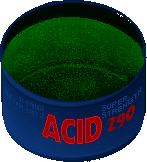

 Q:
Likewise, are there liquids that are more tenacious than water - drips that
are as a large as a golf ball?
Q:
Likewise, are there liquids that are more tenacious than water - drips that
are as a large as a golf ball?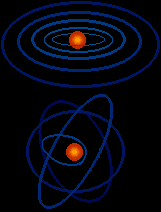


 Gravity of moon wrong?
 Diamond's melting point. Is Liquid Diamond possible?
 The taste of liquid nitrogen, oxygen, hydrogen and mercury
 Momentous water gravity ball